


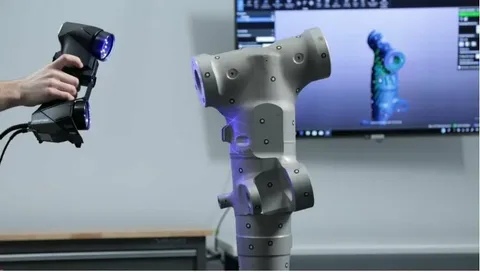
3D scanning is rapidly transforming the way industries approach design, manufacturing, healthcare, construction, and more. The future of 3d scanning is incredibly promising, with continuous advancements in technology allowing for increasingly accurate, faster, and more cost-effective scans. In this article, we will explore how 3D scanning is revolutionizing various industries and what the future holds for this groundbreaking technology.
What is 3D Scanning?
3D scanning is the process of capturing the physical dimensions of an object or environment and converting it into a digital 3D model. This process uses lasers, light sensors, and photogrammetry to create highly detailed and precise models that can be used for a wide range of applications. These models are invaluable for designers, engineers, architects, and many other professionals who rely on accurate digital representations of real-world objects.
The Future of 3D Scanning in Manufacturing
One of the most significant applications of 3D scanning is in the manufacturing industry. The ability to create precise digital models from physical objects has revolutionized the prototyping and production process.
Streamlining Prototyping and Design
Traditionally, designers and engineers relied on CAD (computer-aided design) software to create product models from scratch. With 3D scanning, manufacturers can capture existing objects and quickly create digital replicas. This reduces the time and cost associated with building prototypes from the ground up. In the future, we can expect even more advanced scanning technologies that will integrate seamlessly with CAD systems, improving design iterations and making the production process more efficient.
Quality Control and Inspection
In manufacturing, quality control is crucial. 3D scanning allows for precise measurement and inspection of parts to ensure they meet specific design tolerances. With advanced scanning tools, manufacturers can detect defects or irregularities in the design, even at microscopic levels, long before production goes into full swing. The future of 3D scanning in manufacturing will likely see increased automation, making it even easier to monitor quality and streamline the production workflow.
How 3D Scanning is Transforming Healthcare
The healthcare industry is another sector seeing dramatic shifts thanks to 3D scanning. Whether for creating custom prosthetics, aiding in surgery planning, or designing medical devices, 3D scanning is providing solutions that were once inconceivable.
Personalized Prosthetics and Implants
In the field of prosthetics, 3D scanning is enabling the creation of personalized devices that are tailored to the exact specifications of a patient’s body. Traditional prosthetics often required manual adjustments, which could be uncomfortable or ineffective. With 3D scanning, clinicians can scan a patient’s limb or affected body part and create a prosthetic that fits perfectly, improving comfort and functionality. The future of 3D scanning in healthcare will likely see even more advanced materials being used, offering improved durability and comfort for patients.
Surgical Planning and Education
3D scanning is also helping surgeons plan procedures with greater precision. By creating 3D models of patients’ organs or affected areas, surgeons can practice and perfect complex procedures before performing them in real life. In the future, as scanning technology becomes more sophisticated, doctors will be able to conduct virtual surgeries on 3D models, offering even more opportunities for pre-surgical planning and patient-specific treatments.
3D Scanning in Construction: Building the Future
The construction industry is another major beneficiary of 3D scanning technology. With the help of 3D models, architects and engineers are able to visualize entire buildings before construction even begins, significantly reducing risks and improving efficiency.
Designing and Visualizing Projects
Using 3D scanning, construction teams can generate highly detailed, accurate models of their projects. These digital models allow for better collaboration, as stakeholders can review and interact with the design before construction begins. With advancements in augmented reality (AR) and virtual reality (VR), the future of 3D scanning in construction will likely offer even more immersive and interactive experiences, making it easier for architects, engineers, and clients to visualize the end result.
Documenting and Analyzing Existing Structures
One of the key advantages of 3D scanning in construction is its ability to scan existing buildings for renovation and retrofitting purposes. By creating an accurate digital model of a building, construction professionals can analyze the structure in detail, identifying weaknesses or areas in need of improvement. In the future, the integration of AI and machine learning with 3D scanning will allow for more intelligent analysis of building conditions, further enhancing the accuracy of building assessments.
The Role of 3D Scanning in Other Industries
Aside from manufacturing, healthcare, and construction, 3D scanning is making waves in numerous other industries. From automotive design to archaeology, 3D scanning is changing how professionals gather data, design products, and preserve history.
- Automotive Industry: Car manufacturers use 3D scanning for reverse engineering and optimizing part designs. The future may see fully automated production lines incorporating advanced 3D scanning for continuous quality control and design iteration.
- Entertainment and Gaming: 3D scanning has revolutionized character design in video games and films. With highly detailed scans of real-world objects and people, animators can create more lifelike and realistic models. The future of 3D scanning in entertainment may include AI-driven character modeling for faster and more realistic results.
- Cultural Heritage: Archaeologists and museums use 3D scanning to digitally preserve artifacts and historical sites. As scanning technology improves, more cultural treasures will be preserved digitally for future generations.
The Future of 3D Scanning: What’s Next?
The future of 3D scanning is bright, with continuous improvements in scan accuracy, speed, and accessibility. As the technology becomes more affordable, we can expect it to permeate even more industries, making it easier to collect and analyze data in ways that were once impossible. With the rise of AI, machine learning, and augmented reality, the future of 3D scanning could bring even more powerful capabilities, offering solutions that extend far beyond what we can imagine today.
As we look to the future, one thing is clear: 3D scanning is set to revolutionize how industries design, create, and interact with the physical world. Whether in manufacturing, healthcare, construction, or beyond, the possibilities are virtually endless. The future of 3D scanning is an exciting one, and its potential to reshape industries is just beginning to unfold.
